How Medical Students Master Anatomy Faster With AI-Powered Quizzes and Study-Notes
Anatomy often presents a formidable challenge for first-year medical students. It is not the conceptual complexity, but the immense volume of structures, relationships, innervations, and clinical correlations that overwhelms them. Traditional study methods, like re-reading textbooks or lecture slides, often lead to mere recognition of terms. They fail to build the instant, confident recall needed for clinical vivas or demanding USMLE questions. Discover how AI is transforming this fundamental learning process.
The Immense Scope of Anatomy Learning
A single anatomy course spans hundreds of structures across multiple body systems. Consider the upper limb alone: you'll encounter the brachial plexus, rotator cuff muscles, radial and ulnar nerve distributions, arterial supply, venous drainage, and their clinical correlations to common injuries. That's just one section of one system. Now, extend that to the thorax, abdomen, pelvis, lower limb, head and neck, and neuroanatomy. You're facing thousands of distinct facts that demand not just comprehension, but precise retrieval under intense time pressure in clinical settings. The most successful students manage this vast volume by studying smarter, not just harder.
Why Traditional Review Methods Fall Short
Many students fall into the trap of passive re-reading. You might review lecture slides, label diagrams, and feel ready. Yet, when an examiner asks you to name the branches of the brachial plexus under pressure, your mind draws a blank. This isn't a lack of effort, it is a flaw in method. Recognition and retrieval are distinct cognitive skills. You can recognize an answer when you see it on a multiple-choice list without being able to generate it from memory. Clinical exams demand generation, not just recognition.
Active recall, which involves testing yourself on material instead of merely reviewing it, is the most effective way to train retrieval. This must occur repeatedly and at spaced intervals, covering the full scope of your anatomy curriculum.
Transform Your Study Materials into Powerful Quizzes with Aistote
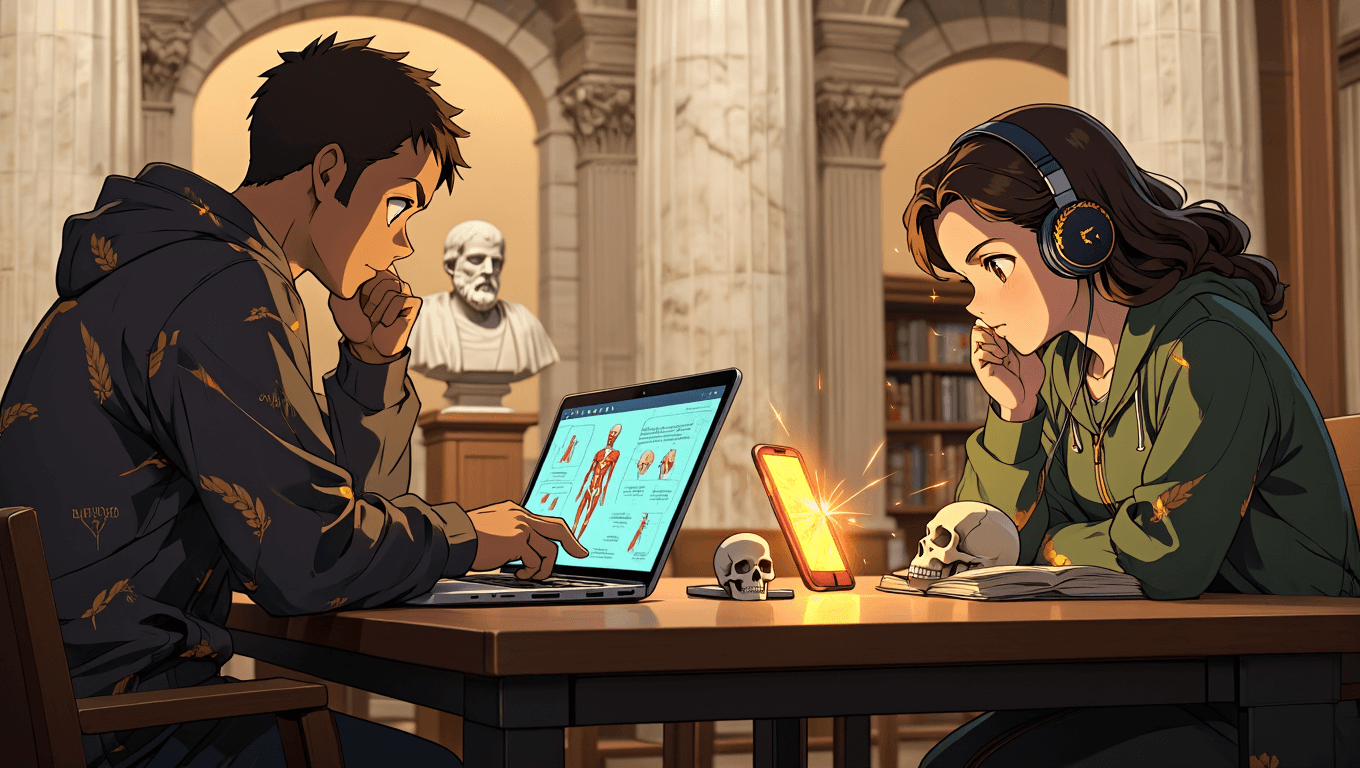
Aistote, launched in 2023, boasts a mature codebase and a robust iteration loop of product development, setting it apart from newer, less proven platforms. Our experienced engineering team designed Aistote to be an AI educational platform that transforms any learning material into engaging quizzes and structured, visual study-notes, often in less than a minute. This capability is invaluable for anatomy students.
Aistote offers unparalleled flexibility in input formats. You can transform absolutely any source:
PDFs and PowerPoint slides (think lecture slides): Upload your professor's materials and instantly generate quizzes on nerve distributions, muscle origins, insertions, and clinical correlations directly from the content you received.
YouTube video links: Learn from video lectures by simply providing a link.
Live audio recordings: Record yourself reading notes or capture a live lecture, and Aistote will generate revision materials instantly.
Even a simple paste of your own handwritten notes can create a targeted drill session in seconds.
The quizzes are highly relevant because the best way to learn any topic is to be asked a good question about it. These aren't generic anatomy questions from a vast bank. They are precisely tailored from your uploaded material, ensuring that the quizzes reflect the specific slides, diagrams, and clinical cases covered in your course. This precision is vital for exam success when your professor tests their specific curriculum.
Master Retention with Spaced Repetition and Gamification
The notorious "forgetting curve" is a major hurdle in anatomy. You might master the brachial plexus in week two, move to the thorax by week four, and by week eight, much of your upper limb knowledge has faded. This often leads to frantic re-learning before exams. Aistote's advanced spaced repetition system automatically combats this. It intelligently tracks your performance across every quiz session, scheduling reviews precisely when they are needed most to solidify your memory, long before forgetting takes hold.
Imagine: brachial plexus content from week two is revisited in week three, then week five, and again in week nine. The frequency adjusts as your retention improves. You don't manage this complex schedule; the algorithm handles it, ensuring you focus on what truly needs reinforcement. This system is integrated with XP-driven gamification, including leagues and streaks, making learning engaging and motivating.
Bridging Basic Science and Clinical Practice
Modern medical education demands more than isolated anatomical knowledge. It requires a deep understanding of clinical application. Why does a radial nerve injury at the spiral groove lead to wrist drop? What's the anatomical basis for referred pain during diaphragmatic irritation? How does a superior sulcus tumor impact the brachial plexus?
Aistote excels at generating quizzes that bridge basic science with clinical reasoning. Our AI-powered platform ensures the content aligns with your course, transforming clinical anatomy lectures into questions that effectively link structure, function, and clinical presentation. This level of integrated understanding is what distinguishes students who simply pass anatomy from those who truly master and apply it throughout their clinical careers.
Engage and Conquer with Collaborative Learning and Tournaments
Anatomy is often a collaborative endeavor, particularly within dissection groups. Aistote supports this natural learning structure with robust group study features. Your dissection team can easily share quiz sets created from the same lecture content. Imagine one student uploading the week's slides, and everyone in the group has access to the quizzes before the next dissection session. Your group arrives prepared, having already engaged in active recall of the structures you are about to examine. This transforms dissection into a powerful reinforcement tool, significantly boosting retention.
Beyond group study, Aistote also offers exciting community tournaments where you can challenge and play against your friends, adding a fun, competitive edge to your learning journey.
Making Neuroanatomy Manageable with Visual Study-Notes
While general anatomy poses its own challenges, neuroanatomy stands as a distinct frontier. Cortical mapping, brainstem nuclei, cranial nerve pathways, spinal cord tracts, and the limbic system all involve intricate three-dimensional relationships that are notoriously difficult to retain. This is where Aistote's beautiful, structured, and visual study-notes truly shine. Our system generates summaries with rich images, employing color-coding to clarify complex information: afferent pathways in one color, efferent in another, key nuclei highlighted, and clinical correlations distinctly flagged. In a subject where visual organization is as critical as factual recall, this automatic structuring significantly reduces cognitive load and makes navigating complex material intuitive.
Your Optimized Anatomy Study Workflow with Aistote
Lecture Day: Immediately after a lecture, upload the slides and take a quick quiz while the information is still fresh. This is your most effective initial retrieval session.
48 Hours Later: Allow Aistote's spaced repetition system to present the same content for a second review. This critical interval is where long-term retention truly begins.
Before Dissection: Dedicate 10 minutes to a targeted quiz on the regional structures you'll be examining. Arrive at your session prepared and proactive, not merely observing.
Exam Week: Rely exclusively on the spaced repetition queue. Forget re-reading. Focus only on retrieving the information the algorithm identifies as needing review.
The Aistote Advantage for Anatomy Mastery
Mastering anatomy demands consistent retrieval practice far more than extensive passive reading. Every hour spent merely re-reading slides could be an hour dedicated to active self-testing, the only method that cultivates the instant recall necessary for clinical exams. Simply upload your materials, generate your quizzes, and let Aistote's spaced repetition algorithm expertly manage your retention throughout the semester. You'll approach your anatomy viva with confidence, truly owning the knowledge.
Aistote is designed for universal accessibility and real-time sync, available on iOS, Android, macOS, Windows, and Web. Your progress is always with you, wherever you study.
Related Guide
Before committing to manual deck creation, read our detailed evaluation of the best spaced repetition app in 2026.